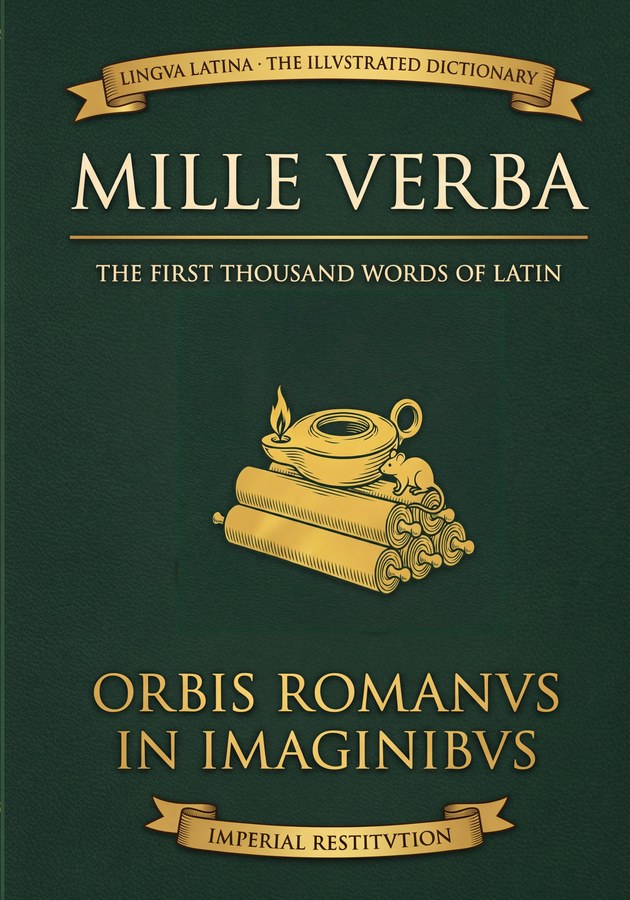
Your first thousand words. In Latin. In pictures.
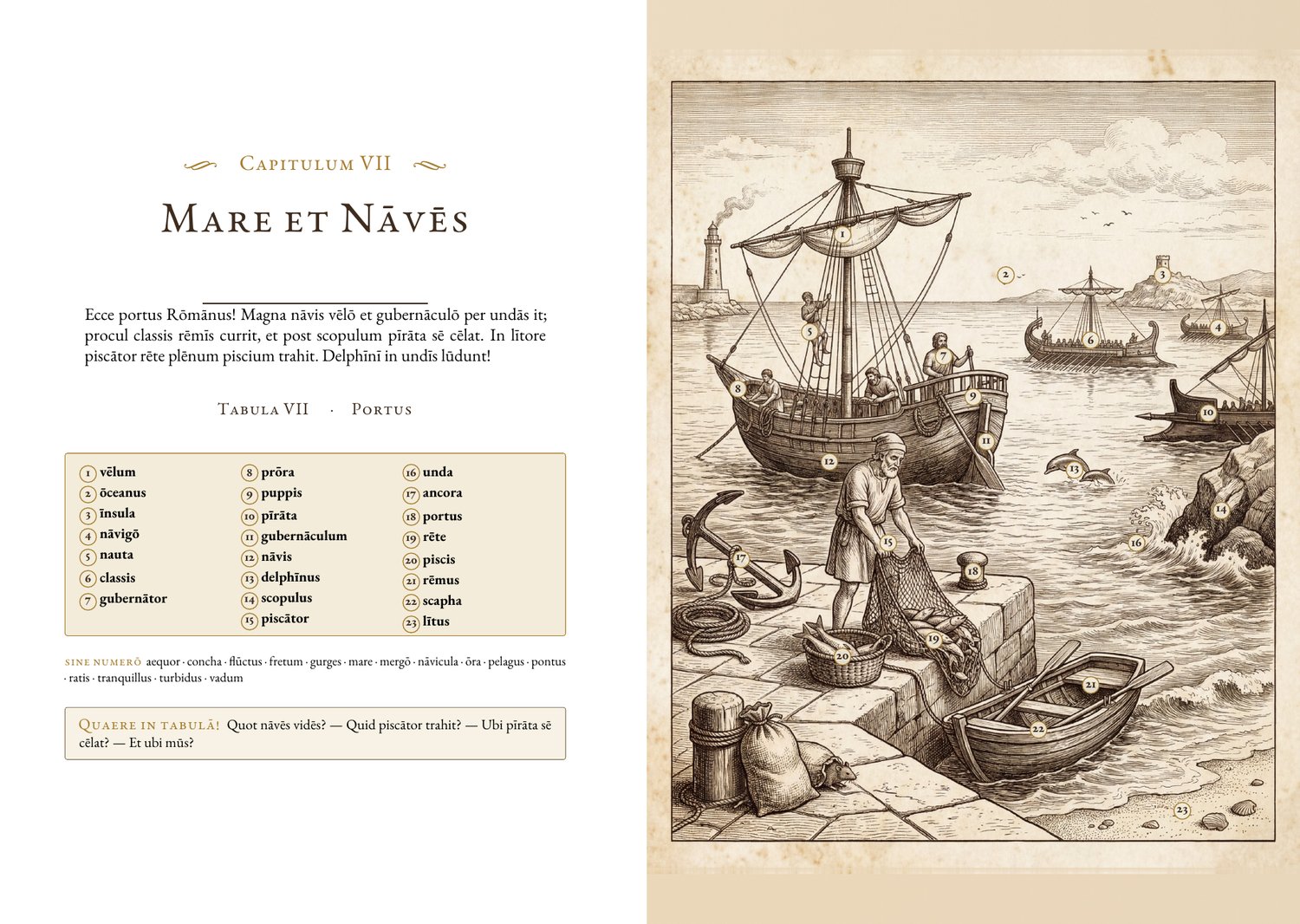
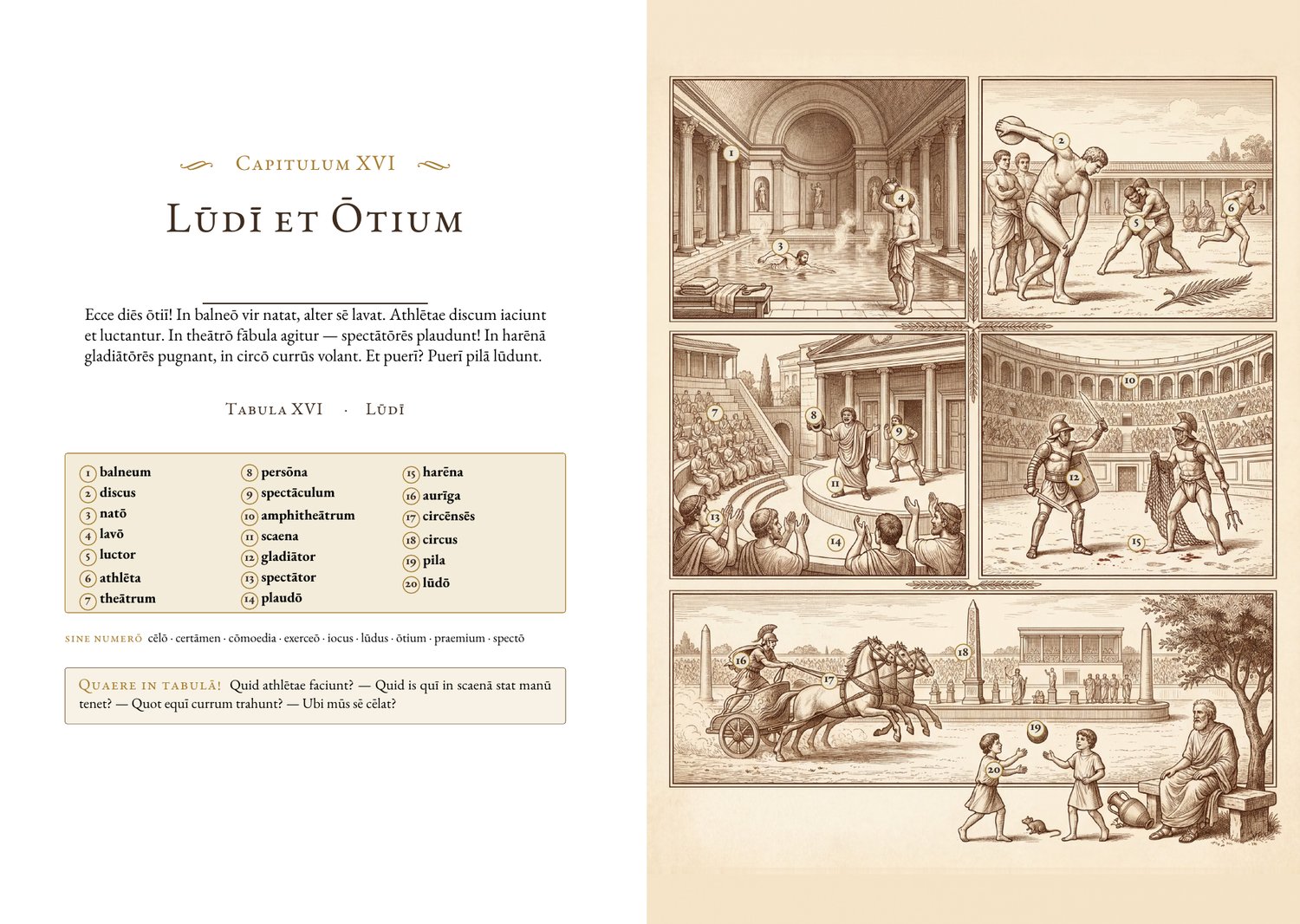
Open this book to any page and you are standing inside Rome: a bath-house where a thief is making off with someone's tunic, a chariot crash at the Circus Maximus, a shipyard, a school, a children's courtyard game of hoops and knucklebones. Thirty-five full-page engraved plates, drawn in the manner of the great eighteenth-century encyclopedias — and every object, person, and action in them numbered and named in Latin.
This is a picture dictionary in the tradition of Comenius' famous Orbis Pictus, reborn for the modern learner. Each plate anchors a chapter of Roman life; the numbered entries that follow define every word in easy Latin, the Ørberg way, with English kept off the page entirely. The pictures do the teaching, the way words were always meant to be learned.
"Orbis Rōmānus, in tabulīs pictus, mīlle verbīs nārrātus."
— the book's own promise
A Closed World of Words
Every definition in Mīlle Verba is written in a controlled vocabulary: each word used to explain another word has its own entry in the book. You are never sent outside the thousand words. Cross-references knit the whole together — SIM. and CONTR. lines point to synonyms and opposites, vidē tabulam notes send you to the plate where a word lives, and a full alphabetical index at the back maps all 1,800 words to their chapters. Under the entries, real Latin: authentic lines from Ovid, Vergil, Pliny the Younger, and Caesar show each word in the wild, exactly as a Roman wrote it.
Where the Thousand Words Come From
Three lists, laid on top of each other. First, the base vocabulary of Ørberg's beloved Lingua Latina per se Illustrata — if you are reading (or about to read) Familia Romana, you are already at home here. Second, the classic "first thousand words" lists behind the world's great picture dictionaries: house and body, food and animals, street and harbor — the things you can point at, in any language. Third, the working vocabulary of the authors this series actually reads: Caesar, Ovid, Vergil, and Pliny the Younger. Where the three lists agree, a word's place was certain; where they differ, we kept what a learner meets again and again in real Latin. The honest count is 1,800 — "mīlle" is the Romans' own round number: mīlle bāsia, mīlle colōrēs, mīlle domōs.
The Dictionary of the Series
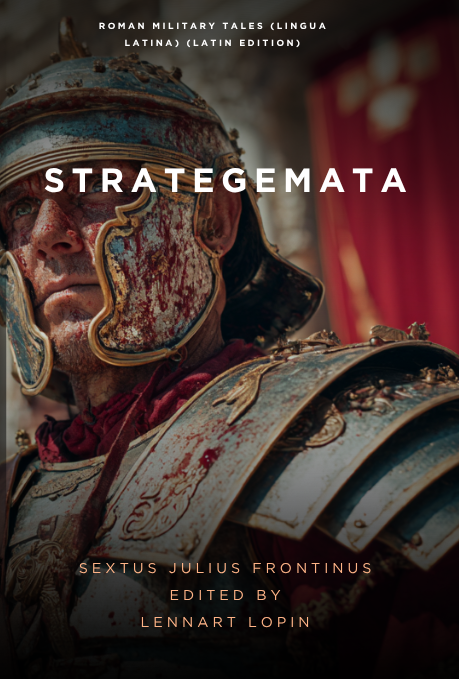
Mīlle Verba is the vocabulary foundation of our Lingua Latina readers: Frontinus' Strategemata, Caesar's Gallic War, Ovid's Metamorphōsēs, Vergil's Aenēis, and Pliny's Epistulae are all built on exactly the vocabulary taught in this volume. Keep it beside whichever reader you are in and every marginal gloss has a home to return to. It serves just as happily beside Familia Romana, in a classical school's Latin I room, or on the desk of a self-taught learner who wants the core of the language in one beautiful, browsable book.
And One More Thing
A mouse hides in every plate. Thirty-five plates, thirty-five mice — behind a grain sack, asleep in an arabesque, inside a fallen comedy mask. The book tells you this in Latin, once, and then lets you hunt: in omnī tabulā huius librī ūnus mūs sē cēlat — quaere eum! Children find them faster than their parents. Good luck.